


Last Updated: November 10, 2026
Quick Summary
To learn how to incorporate collagen into your daily routine, pick a time you never miss, pair collagen with something you already do, and keep the dose steady. The best time to take collagen is whenever you will actually remember to take it, since consistency matters far more than timing. Stir unflavored powder into warm coffee or tea, or shake it into cold drinks, and give it several weeks of daily use before judging results.
- Collagen works like a nutrient, not a drug, so daily consistent intake over weeks matters most.
- Add the liquid first, then the powder, and use warm rather than boiling liquid to avoid clumps.
- Check the serving size in grams on the label, since one brand's scoop may be 10 g and another's 20 g.
- Aim for vitamin C sources, protein foods, and zinc and copper sources alongside your supplement.
- Review your tracked goals at four, eight, and twelve weeks of consistent use.
Table of Contents
- Why a Collagen Routine Beats an Occasional Scoop
- The Best Time to Take Collagen (and Why Timing Matters Less Than Consistency)
- How to Mix Collagen Powder Into Drinks Without the Clumps
- Foods That Boost Collagen Production Alongside Your Supplement
- How Long to Take Collagen for Skin Results Before You Judge It
- What Natural Health Products Regulations Canada Mean for Your Collagen
- Building Your Daily Collagen Habit With Health IS Wealth
- Frequently Asked Questions
Why a Collagen Routine Beats an Occasional Scoop
Collagen is the most abundant protein in your body. After your mid-20s, your natural collagen production starts to slow.
Here is the tension most guides skip: collagen is not a painkiller. It works like a nutrient, not a drug.
The best approach is simple: pick a time you never miss, pair collagen with something you already do, and keep the dose steady.
The Best Time to Take Collagen (and Why Timing Matters Less Than Consistency)
The best time to take collagen is whenever you will actually remember to take it. There is no single "magic hour." What matters far more is hitting your serving size every day.
Collagen peptides are broken down into amino acids like glycine, proline, and hydroxyproline. Your body pulls from that pool as needed. It does not stockpile a single morning dose for evening use.
So forget the clock. Focus on consistency.
Morning, Afternoon, or Before Bed: Matching Collagen to Your Schedule
Match collagen to your existing rhythm, not an ideal one:
- Morning coffee or tea: Easiest for most people. Stir it in while the drink is warm.
- Post-workout protein shake: Pairs well if you already blend a shake.
- Evening routine: Good if mornings are chaotic. Add it to a warm drink before bed.
Choose a slot you are unlikely to skip.
How to Mix Collagen Powder Into Drinks Without the Clumps
Clumps happen for one reason: the powder hits liquid and gels on the outside before it dissolves. The fix is order, temperature, and agitation, and a little knowledge of what your specific product is designed to do.
Follow these steps for a smooth drink every time:
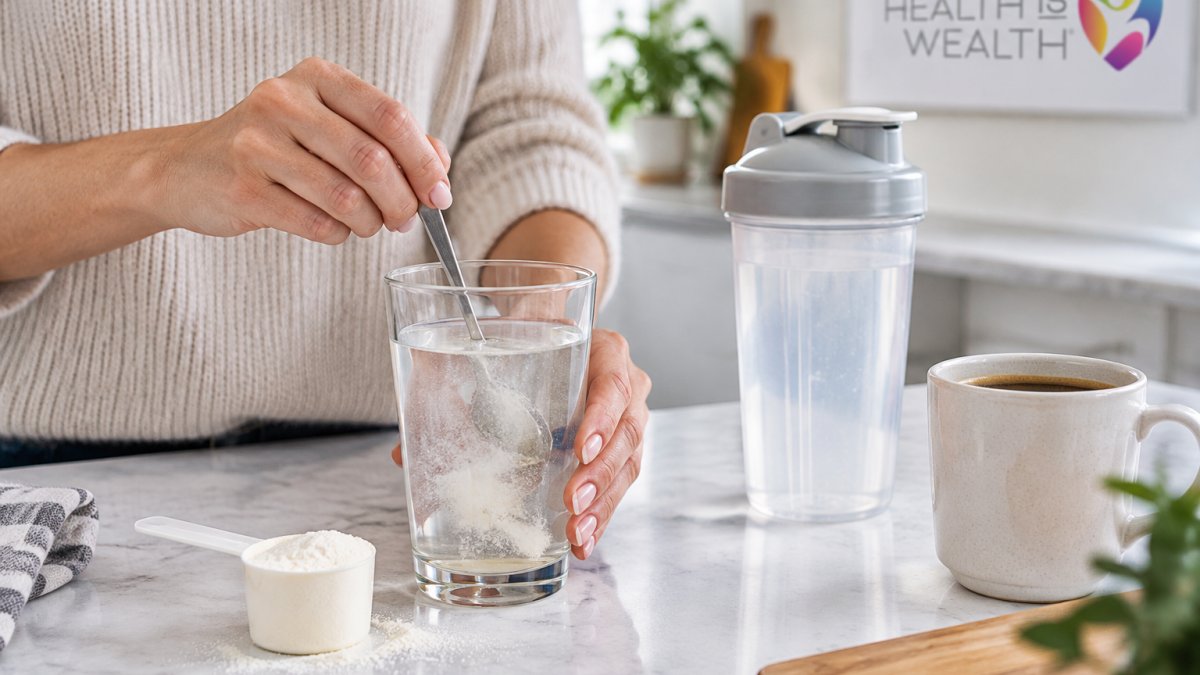
- Add the liquid first, then the powder on top.
- Use warm, not boiling, liquid. Boiling water can make it clump.
- Stir or shake right away for 10 to 15 seconds.
- For cold drinks, shake in a bottle rather than stirring with a spoon.
- Add powder gradually if you are mixing a large serving.
You can find our hydrolyzed bovine collagen powder, an unflavored form that mixes into most drinks.

Read the Label Before You Mix: Serving Size, Format, and What "One Scoop" Means
Before you worry about clumps, confirm what a serving actually is. Collagen products are not dosed the same way, and the scoop in the tub is not a universal measure.
- Check the serving size in grams, not scoops. One brand's scoop may be 10 g while another's is 20 g. The label's nutrition panel is the only reliable guide.
- Distinguish formats. Hydrolyzed peptides dissolve in liquid; gelatin blooms and gels; collagen in capsule or tablet form is swallowed, not mixed. A product marketed as "collagen powder" may be any of these.
- Do not assume one dose fits everyone. Labels give a serving size, not a personal prescription. If you are unsure whether a product suits your needs, ask a pharmacist or your health care provider rather than doubling up.
A common pattern is to start with the label's stated serving and keep it steady for several weeks before changing anything. More is not automatically better, and the goal is a routine you can repeat.
Collagen in Hot Coffee, Tea, and Other Warm Beverages
Warm drinks are the most popular vehicle for collagen, and for good reason. Coffee and tea are daily habits already.
A few practical notes:
- Let coffee cool for a minute before adding powder.
- Stir briskly; collagen dissolves faster in warm liquid.
- Tea works the same way. Green or herbal both fine.
If you drink iced coffee, shake the powder into a small amount of warm water first, then add the cold liquid.
Cold Drinks, Smoothies, and Carbonated Beverages
Cold liquids are where most clumping complaints come from, because collagen peptides hydrate more slowly in cold water.
- Smoothies: add powder after the liquid and softer ingredients, then blend. If your blender is weak, whisk the powder into a splash of water first.
- Cold water or juice: use a shaker bottle with a wire ball and shake hard for 15 to 20 seconds. Stirring with a spoon in a glass rarely works.
- Carbonated drinks: add the powder to a small amount of still water first, then top with the sparkling beverage. Adding powder directly to fizzy liquid tends to foam and clump.
Mixing Into Foods: Soups, Sauces, Yogurt, and Baked Goods
Collagen does not have to go in a drink. It can be used in some foods, though texture may vary.
- Hot soups and sauces: whisk in at the end of cooking, off the heat, to avoid gelling or foaming.
- Yogurt, oatmeal, and applesauce: stir in a spoonful; the texture is usually unnoticeable.
- Baked goods: collagen is not a substitute for flour or eggs. It can be added to some recipes, but it does not set or bind the way gelatin does, so follow a tested recipe rather than improvising.
Watch out: adding collagen to a boiling pot and cooking it for a long time can change the texture of the dish. Add it late and stir well.
Troubleshooting: Taste, Texture, and Foam
- Taste: unflavored peptides are close to tasteless in most drinks; flavored versions can sweeten coffee or tea more than expected.
- Texture: a slight thickening in cold liquids is normal. If it feels gritty, the powder has not fully hydrated, shake longer or use warm water first.
- Foam: common in shaker bottles and carbonated drinks. Let it settle for a minute or skim it off.
If a product consistently clumps no matter what you do, check whether it is hydrolyzed peptides or another format. The label tells you, and the format determines how it behaves in liquid.
Foods That Boost Collagen Production Alongside Your Supplement
A well-balanced diet rich in whole foods supports the body's natural collagen production. (Source: Health Canada's guidelines on dietary reference intakes)
Foods that boost collagen production include:
- Vitamin C sources: citrus fruits, leafy greens, berries, peppers.
- Protein foods: chicken, fish, egg whites, and bone broth.
- Glycine-rich foods: bone broth and gelatin.
You do not need a perfect diet. Aim for color and variety on your plate. A supplement fills gaps; it does not replace food.
How Long to Take Collagen for Skin Results Before You Judge It
Consider giving it several weeks of daily use before judging results, as changes in skin and joints tend to build gradually.
Why the Evidence Is Limited, and What That Means for You
the research base is smaller and more variable than the marketing around them suggests. Studies often use different doses, different product types, and different ways of measuring outcomes, which makes it hard to draw one firm conclusion for everyone.
That does not mean collagen is useless. It means the honest position is: some people notice changes, some do not, and the effect is usually modest rather than dramatic.
Set a Specific Goal Before You Start
"Better skin" is too vague to evaluate. Pick one or two concrete things you want to track, and write them down before you begin.
- Skin hydration: does your skin feel less tight after cleansing?
- Nail strength: are nails peeling or breaking less often?
- Joint comfort: is a specific activity, stairs, a morning walk, easier?
Choose goals you can actually observe without special equipment. A phone photo taken in the same light once a week is a simple, low-effort record.
A Simple Tracking Method
A short weekly check-in is more useful than a daily score, because day-to-day variation is normal.
- Pick one day of the week and a consistent time.
- Rate your chosen goal on a simple scale, such as 1 to 5.
- Note anything that changed, sleep, stress, season, new products.
- Review the log at four, eight, and twelve weeks.
If nothing has changed by twelve weeks of consistent use, consider whether the product is the right fit for you or whether your goal needs a different approach.
What to Watch For, Honestly
- Skin: subtle changes in hydration and elasticity, not a dramatic overnight shift.
- Nails: often the first place people notice stronger nails.
- Hair and joints: slower, and harder to measure on your own.
Watch out: if you change several products at once, a new serum, a new multivitamin, a new collagen, you will not know which one is responsible. Change one thing at a time.
When to Stop or Ask a Professional
Stop and speak with a health care provider if you notice an allergic reaction, digestive upset that does not settle, or any symptom that concerns you.
Set expectations now. Collagen is a long game. Skipping days resets the clock, and no supplement replaces sleep, sun protection, and a varied diet.
If you are committed to a daily routine, a three-pack of hydrolyzed collagen powder helps you stay stocked long enough to actually see results.

What Natural Health Products Regulations Canada Mean for Your Collagen
In Canada, natural health products are regulated by Health Canada (Regulating Natural and Non-prescription Health Products: The Path Forward). Look for licensed products when shopping.
What this means for you:
- Check for an NPN on the label.
- Look for clear serving size and ingredient details.
- Buy from brands that state where and how they manufacture.
As documented in Health Canada's guidance on natural health products, licensed products must meet labeling and quality standards. This is not the same as pharmaceutical approval, but it is a real regulatory check.
Our collagen is made in a Health Canada licensed, GMP-certified facility.
Building Your Daily Collagen Habit With Health IS Wealth
A habit sticks when it is easy. Here is a simple routine you can copy:
Step |
What to Do |
When |
|---|---|---|
1 |
Pick your anchor drink |
Today |
2 |
Measure one serving |
Daily |
3 |
Stir powder into warm liquid |
Same time each day |
4 |
Track it for two weeks |
Ongoing |
5 |
Review at eight weeks |
Week 8 |
Pair the routine with a reward. Our Loyalty Rewards program lets you earn points on repeat orders and redeem them for savings, which makes a daily habit easier to keep. If you prefer to shop in person, you can find our products at retailers near you.
For deeper guidance on choosing and using collagen, read our guide to collagen supplements.
Building a collagen routine is not complicated, but it does ask for patience and consistency. We built our hydrolyzed bovine collagen peptides for exactly that kind of daily use: unflavored, easy to mix, and made in a Health Canada licensed facility.
Frequently Asked Questions
What is the best time of day to take collagen supplements?
There is no single best time. What matters most is taking your collagen at the same point every day so it becomes automatic. Many people add it to their morning coffee or smoothie because that slot already exists in their routine. Others prefer it after a workout or in the evening. Pick a time you will not skip, and keep the serving size consistent. If you take other medications, speak with a pharmacist or your doctor about spacing.
Can I mix collagen powder with hot coffee or tea?
Yes. Hydrolyzed collagen peptides dissolve in warm liquids, so stirring a scoop into coffee or tea works well. Add the powder after the liquid has cooled slightly and stir or whisk for 10 to 15 seconds to avoid clumps. Very high heat for long periods is not necessary, and there is no benefit to boiling it. If you use a milk frother or shaker, you will get a smoother texture with less stirring.
How long does it take to see results from daily collagen intake?
Give it several weeks of consistent daily use before judging results. Collagen supports skin elasticity, nail strength, and joint comfort, but these are gradual changes tied to your body's own turnover cycles. Take a photo at the start and note how your joints feel, then compare after three months. If you notice nothing by then, review your serving size and product quality rather than simply adding more.
What should I look for in a high-quality collagen supplement?
Look for a product that is Health Canada licensed, a named collagen type such as Type I and III, and a clear hydrolyzed peptide form. Check that the label states the source, such as grass-fed bovine, and the serving size in grams. A GMP-certified facility adds confidence. Health IS Wealth collagen peptides are made in a Health Canada licensed, GMP-certified facility.


Comments